Canonical Lineage
Why the Doctrine Was Inevitable
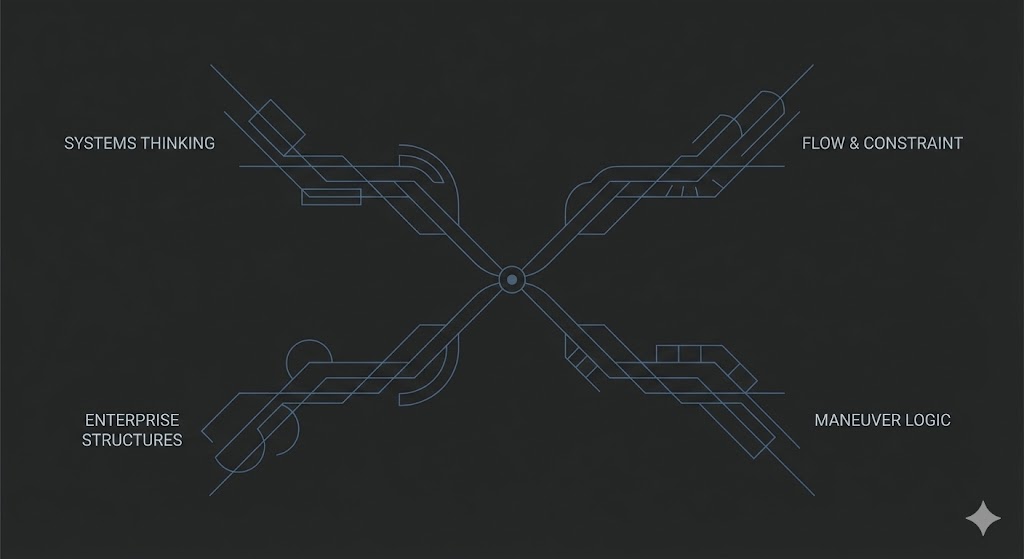
THE KINETIC ENTERPRISE did not appear in isolation. It is the structural convergence of multiple lineages that evolved independently — each solving a local problem, none fully resolving the system under speed.
Systems
Feedback, emergence, and non-linearity. Outcomes are shaped by structure, not intent.
Flow & Constraint
Throughput is governed by bottlenecks. Utilization trades away maneuverability.
Maneuver
Speed under pressure: intent, bounded autonomy, local initiative, and tempo.
The Lineage
This doctrine synthesizes four domains that rarely meet cleanly in enterprise discourse: systems thinking, flow/constraint, software delivery as organizational physics, and maneuver logic. The point is not to “borrow metaphors.” The point is to name the structural laws the enterprise is already obeying — whether it admits it or not.
The Foundational Laws
These are not opinions. They describe how complex systems behave regardless of leadership posture, tooling choices, or transformation narratives.
Systems Thinking
- Feedback loops dominate outcomes.
- Systems optimize for constraints, not stated goals.
- Control delays compound non-linearly.
Flow & Constraint
- Throughput is governed by bottlenecks.
- Utilization destroys maneuverability.
- Speed collapses before failure becomes visible.
Decision & Maneuver
- Tempo outcompetes mass under volatility.
- Local initiative beats centralized certainty.
- Interfaces outperform orders at scale.
The Inversion
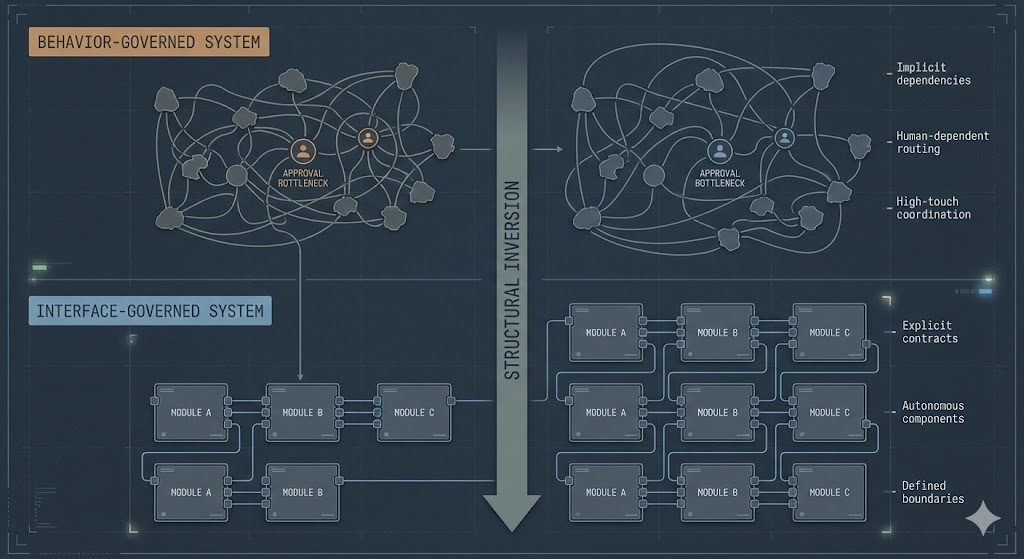
Industrial operating models govern behavior to suppress variance. That worked — when variance was a defect. In a cognitive economy, variance is information. The enterprise freezes because it attempts to manufacture novelty using a machine designed to manufacture conformity.
The core move is a structural inversion: stop governing behavior and govern interfaces. Bound the connections. Make intent and contracts explicit. Allow autonomous internal motion.
Practitioner Lineage (Selected)
This is a partial map of the practitioner and academic work that shaped the problem-space. The doctrine is a synthesis, not a replacement.
Systems, Flow, Constraint
- Goldratt — The Goal
- Goldratt — Critical Chain
- Meadows — Thinking in Systems
- Ackoff — Re-Creating the Corporation
Software & Org Physics
- Kim, Behr, Spafford — The Phoenix Project
- Kim et al. — The DevOps Handbook
- Kersten — Project to Product
- Forsgren, Humble, Kim — Accelerate
Strategy, Design, Maneuver
- Rumelt — Good Strategy / Bad Strategy
- Christensen — The Innovator’s Dilemma
- Skelton & Pais — Team Topologies
- Boyd — Patterns of Conflict