Decision Latency as the Governing Variable
Decision latency is the elapsed time between intent and coordinated action across a distributed organisation. It is the primary constraint in modern enterprise execution, and it is structural in origin.
Most organisations measure performance through output metrics: throughput, delivery velocity, cost per unit. These metrics capture activity. They do not capture the friction that limits the conversion of intent into outcome. Decision latency is that friction. When an organisation invests in technology and finds that execution does not improve proportionally, the explanation is almost always a decision latency problem that the technology investment did not address.
Decision latency is not a consequence of slow people or inadequate processes. It is a consequence of operating architecture. The approval chains, governance layers, and coordination mechanisms that large organisations build to manage risk and maintain control encode latency into every decision cycle. At low operating tempo, this latency is tolerable. Under sustained speed, it becomes the dominant constraint.
The Structural Inversion
The diagram below illustrates the central tension in modern enterprise operation. Technology capability, the potential energy available to the organisation, has accelerated significantly across every domain. Organisational permission, the capacity to actually deploy that capability through the decision and governance architecture, has not kept pace.
The Kinetic Gap: technology capability (potential) versus organisational permission (actual motion)
The gap between these two curves is the Kinetic Gap. It is not a technology deficit. Most organisations with this gap have invested heavily in technology. It is a structural deficit: the operating model has not been redesigned to match the environment in which it is now operating. The industrial chassis, designed for a stable world, is being asked to carry the load of a volatile one.
Flow as a System Property
The doctrine applies a constraint-based view of enterprise throughput. In any system, the rate of output is governed by the most constrained element in the flow. Investing upstream or downstream of the constraint does not improve system throughput. It increases work-in-progress and creates the appearance of activity while the actual bottleneck remains untouched.
In enterprise execution, the constraint is almost always in the decision layer, not in the execution layer. Teams are capable. Technology is available. The blockage is in the approval chain, the governance process, the coordination overhead between functions that operate with different incentives and timelines. Improving execution capability without addressing decision latency is like widening a motorway either side of a bridge that has not been widened. More capacity, same bottleneck.
Flow-based thinking also changes what you optimise for. Local optimisation, improving the performance of individual functions or teams in isolation, frequently degrades system-level throughput by creating imbalances that pile up against the constraint. The model requires a system-level view of where work actually stops, not where it moves most efficiently.
Governance as Constraint, Not Control
The industrial operating model treats governance as a control mechanism: a set of approval processes and oversight structures designed to prevent error and maintain accountability. In stable environments, this is rational. The cost of the governance overhead is outweighed by the reduction in error rate.
Under conditions of sustained speed, this calculus inverts. The governance overhead, encoded as approval chains and review gates, becomes the primary source of decision latency. Every decision that must travel through a governance layer adds elapsed time to the cycle. In high-tempo environments, this is not a manageable friction. It is a structural brake.
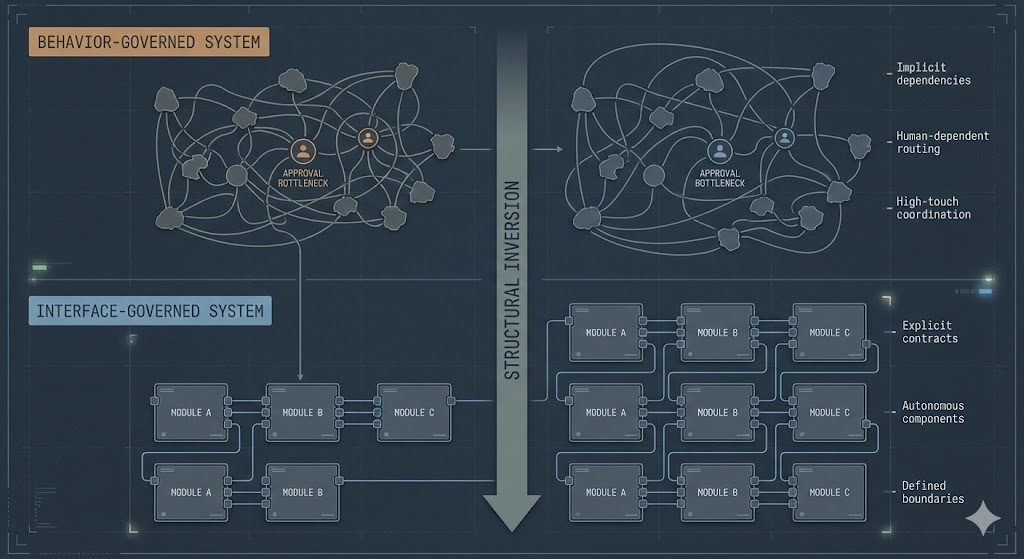
The model proposes a different architecture: governance encoded as constraints rather than control. Rather than requiring decisions to travel through a governance layer for approval, the governance boundary is defined in advance. Within it, decisions are made locally at the tempo the environment requires. Outside it, escalation applies. This preserves accountability and risk management while removing the latency that centralised approval generates.
Structural Absorption of Change
The final element of the model concerns coherence under pressure. Organisations that respond to environmental change by adding process, creating new oversight structures, or layering coordination mechanisms tend to reduce their own adaptability over time. Each addition is locally rational. The cumulative effect is a system that becomes progressively more brittle as the complexity of its internal coordination exceeds its ability to maintain coherence.
Structural coherence, the capacity to absorb change without fragmentation, is a design property. It is built into the architecture of the operating model through clear interfaces, defined decision rights, and governance that enables rather than constrains local tempo. Organisations that have it can absorb significant environmental volatility without destabilising. Organisations that lack it fragment under pressure, defaulting to heroic individual effort and informal workarounds that temporarily restore motion while leaving the structural problem untouched.