The value of tracing lineage is precision. Doctrines that do not acknowledge their origins tend to rediscover known territory slowly and imprecisely. The Kinetic Enterprise draws explicitly from three bodies of work, each of which arrived at compatible conclusions through different empirical routes. That convergence is the intellectual basis for the doctrine's core claims.
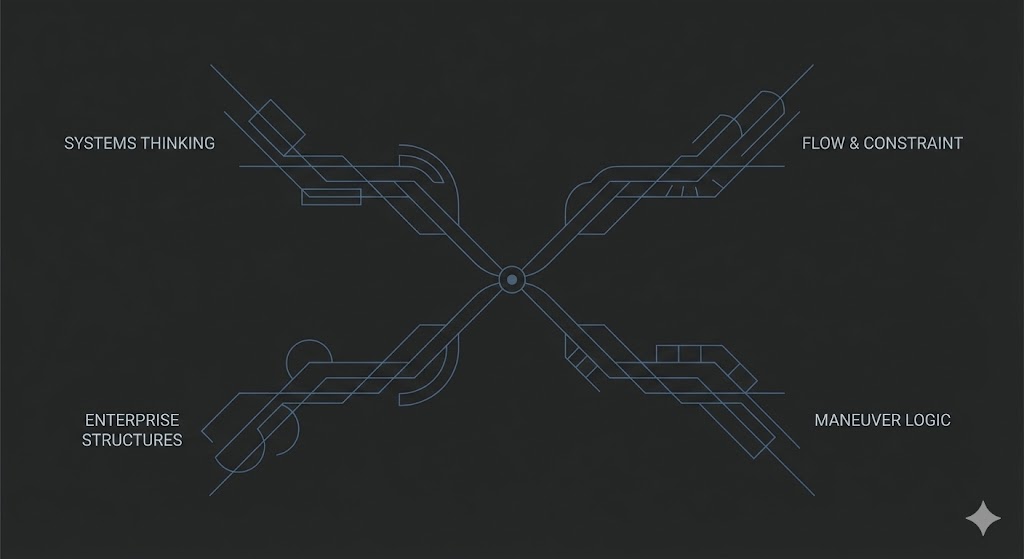
Three independent intellectual traditions converging on the same structural diagnosis
Systems Thinking
The systems thinking tradition, developed through the work of Jay Forrester, Donella Meadows, and Peter Senge, established a foundational principle: in complex systems, structure determines behaviour. Outcomes are not primarily a function of the quality of individuals operating within a system. They are a function of the feedback loops, delays, and constraints built into the system's architecture.
Forrester's industrial dynamics work in the 1950s and 1960s demonstrated that the oscillations and instabilities observed in industrial supply chains were not the result of poor management decisions. They were the inevitable output of the system's structure: the delays between signals and responses, the policies governing inventory and production, the information flows available to decision-makers at each node.
Meadows formalised this into the concept of leverage points: places within a system where a small shift can produce large changes in behaviour. The most powerful leverage points are not in parameters (changing numbers) but in structure (changing the rules of the game). Senge translated this into organisational language in The Fifth Discipline, naming the discipline of systems thinking as the capacity to see structure rather than events, and to act on causes rather than symptoms.
What this lineage contributes to the doctrine: the analytical method. When the doctrine argues that decision latency is structural in origin, it is applying the systems thinking principle that organisational outcomes emerge from architecture, not from individual behaviour. Improving individual performance within a structurally broken system produces marginal gains at significant effort. Changing the structure changes the system's behaviour.
Flow and Constraint
The second lineage runs through Eliyahu Goldratt's Theory of Constraints and the Lean manufacturing tradition. Both arrived, independently and from different starting points, at the same structural insight: the throughput of any system is governed by its most constrained element. Optimising non-constraints does not improve system output. It increases inventory and cost while the constraint remains the binding limit.
Goldratt's formulation, developed through The Goal and subsequent work, was precise: identify the constraint, exploit it fully, subordinate everything else to that decision, elevate the constraint, and repeat. The power of this approach is not in its simplicity but in its discipline. Most organisations optimise where it is easiest to measure improvement, not where the actual constraint sits. The result is impressive local performance with no system-level benefit.
The Lean tradition, drawing from the Toyota Production System, contributed a complementary insight: waste, defined as any activity that consumes resources without producing value, is most visible in handoffs and waiting time rather than in active work. The most significant inefficiencies in complex processes are in the gaps between activities, not in the activities themselves.
What this lineage contributes to the doctrine: the constraint model for enterprise execution. When the doctrine argues that investing in execution capability without addressing decision latency is structurally ineffective, it is applying the constraint principle. Decision latency is the constraint. Everything else is upstream or downstream of it.
Decision and Manoeuvre
The third lineage comes from military doctrine, specifically from John Boyd's work on the OODA loop (Observe, Orient, Decide, Act) and from the Auftragstaktik tradition of mission command that developed in the Prussian and later German military.
Boyd's contribution was a model of competitive advantage under uncertainty: the organisation that can complete its observation-orientation-decision-action cycle faster than its adversary can operate inside that adversary's decision cycle, creating confusion and forcing responses to situations that have already changed. Speed of decision is not about moving faster. It is about completing decision cycles at a tempo that maintains initiative.
The Auftragstaktik tradition arrived at a parallel insight from a different direction: in conditions of uncertainty and rapid change, centralised command creates fatal delays. The superior approach is to communicate intent clearly, define the boundaries of acceptable action, and allow local commanders to make decisions at the tempo the situation requires. This requires a different kind of discipline than centralised command: not the discipline of following orders, but the discipline of acting in accordance with intent when orders cannot be received or have been overtaken by events.
What this lineage contributes to the doctrine: the operational model for distributed decision-making. The doctrine's argument for governance as constraint rather than control is structurally identical to the mission command principle: define intent and boundaries, enable local tempo, maintain coherence through shared orientation rather than through approval chains. The military evidence is not the origin of the doctrine's argument. It is corroborating evidence from a domain that has been solving the same structural problem under more acute conditions for longer.